

Music during asana practice –
A no-go?
Authored: Moritz Ulrich | Reading time: 4 minutes | Last edited: 10 December 2025
A topic that divides the yoga world:
The same question keeps cropping up in the yoga scene:
„Is it permissible to play music during asana practice?“
It is a topic that sparks debate – both online and offline. Some consider music in yoga to be untraditional. Others find it inspiring and supportive. But what does tradition really say? And how do we, as modern yoga teachers, deal with this today?
In this article, we examine:
- Traditional backgrounds to sound & yoga
- Why Asana + music have historically been neither prohibited nor
is occupied - Why thinking in terms of „right“ and „wrong“ is of little help
- Practical tips for the ideal yoga playlist
- How music can be used effectively without
be distracting

The most important points in brief – the 3 key points
- Sustainability as lived practicePeace Yoga Berlin understands environmental awareness as an honest attitude - decisions are based on mindfulness, responsibility and the real conditions of everyday studio life instead of perfectionist expectations.
- Conscious choice instead of green labels: Cleaning products, studio products, coconut water or yoga mats are not assessed across the board, but are considered in terms of origin, durability, resources and actual benefits - pragmatism instead of ideology.
- Mindfulness beyond the mat: Travelling, consumption and teaching are viewed with compassion instead of morality - sustainability becomes a yogic path that enables reflection, connection and growth without shame or black and white thinking.
Music in yoga – traditional or modern?
Nada Yoga: The yogic practice of sound
Sound has always played an important role in many traditions.
The so-called Nada Yoga sees the path to knowledge as:
- vibration
- vibration
- external and internal sounds
The term Anahata Nada describes the eternal, undefeated sound, which always exists – a metaphor for enlightenment and deep inner perception.
But it is important to note that:
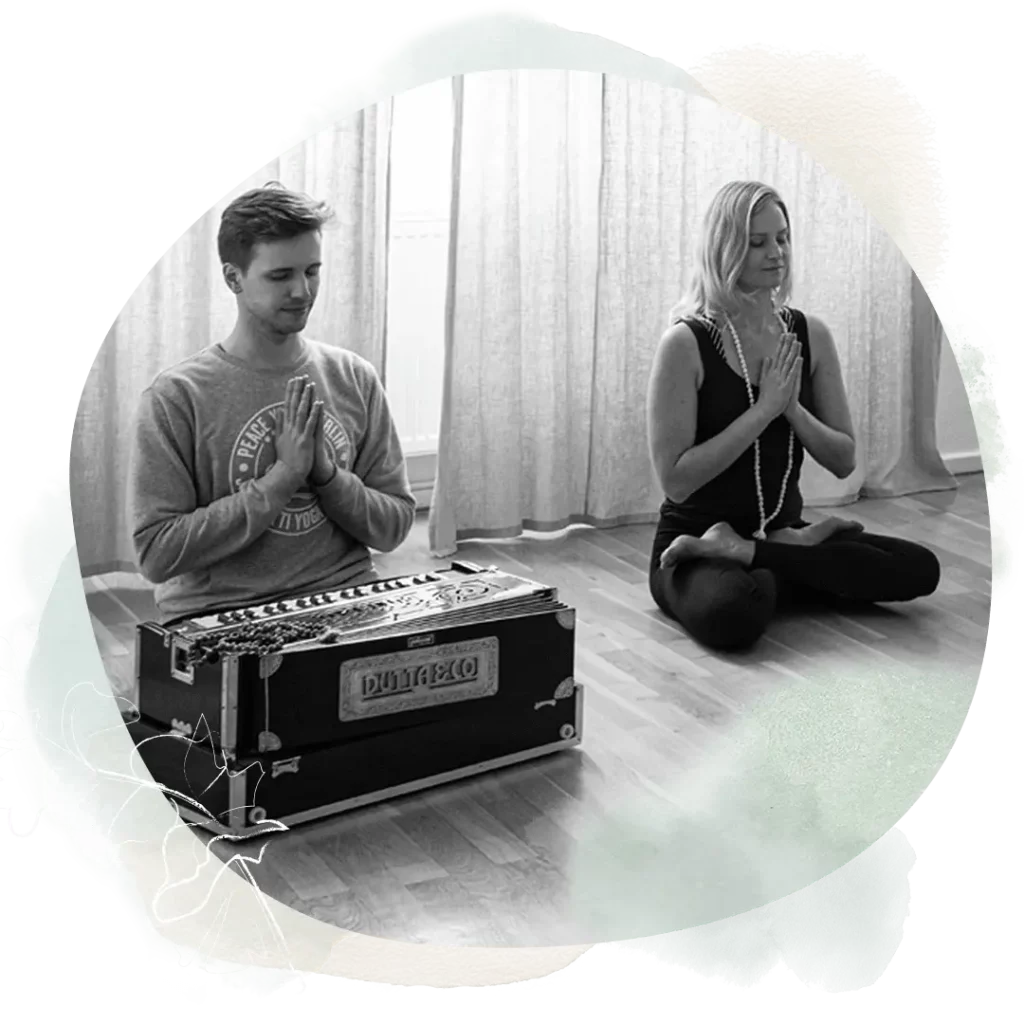
Nada Yoga does not automatically mean music during the asanas. Nada yogis often do not work with asanas at all, but rather with sound as a spiritual practice.
Music in the Indian yoga tradition
Even independently of Nada Yoga, sound plays a role in Yoga always played a central role:
- Singing mantras
- Recitation of Vedic texts
- traditional Indian music
Sounds convey knowledge, accompany rituals and create structure.
However: Historical evidence for asana practice with There is no music. Nor is there any evidence that one can none Play music.
There is therefore no „traditional prohibition“.
Asana sequences are themselves a modern development.
The modern form of Vinyasa Flow – that is:
- fluid sequences
- synchronised with breathing
- dynamic asana sequences
... is historically speaking very young. For thousands of years, asana practice was hardly comparable to its current form. It is therefore difficult to use a tradition as a benchmark that did not even exist in this form at that time.
Modern practice requires modern questions – and flexible answers.
Tradition or modernity? Why „right vs. wrong“ is not helpful
Many discussions arise from the desire for clarity: „Is it allowed?“ – „Is it traditional?“ – „Is it wrong?“
However:
- Traditions have constantly evolved
- Different lines have different perspectives
- Geography, zeitgeist, teacher personalities – all of these shape practice.
Yoga is a living path – not a rigid set of rules.
Instead of thinking in black and white, we can deal with it openly:
- Some prefer to practise in silence
- Others with music
- Many like both, depending on their mood and the type of lesson.
Music as support for practice – not as a distraction
Music can be a Yoga class open the senses, support breathing or enhance an emotional quality. Silence, on the other hand, can sharpen perception and make inner sounds audible. Both have advantages.
The problem only arises here:
- When music distracted, instead of supporting.
- When they just background chatter is.
- When they not deliberately chosen will be.
Therefore, the following applies: Music in yoga is not a no-go – but it should be used mindfully.
How to create a really good yoga playlist
A playlist should never be random. It should reflect practice. accompany, carry and support. Here are some criteria you can check for each track:
Why is this song here?
- Does it support the intention of the lesson?
- Does the text fit with practice – or does it get in the way?
- Does the song create the desired mood?
Rhythm & Breathing
- Is the beat too fast?
- Does it promote calm or energy – depending on the phase of the class?
Instruments & Soundscapes
- Do they support grounding, expansiveness, energy, centring?
- Do they help to reinforce the topic of the lesson?


Chakras & Elements
If a lesson is themed:
- Fire → energetic music
- Earth → calm, deep sounds
- Heart space → open, soft soundscapes
Use inspiration
It is perfectly acceptable to use other people's playlists or to draw inspiration from them.
Moritz Ulrich even explicitly states:
„Feel free to take my playlists – that's what they're there for.“
Copy-paste is not a problem – as long as we use it consciously and know what we are sharing or passing on.
Conclusion: Music in asana practice – yes or no?
From this perspective, it becomes clear that:
❌ There is no traditional prohibition.
❌ There is no historical obligation to remain silent.
❌ There is no universal no-go.
Instead, the following applies:
✔️ Music can inspire
✔️ Music can carry you away
✔️ Music can be part of modern yoga practice
✔️ Silence remains valuable
Both can coexist.
✔️ The decision may be situational and individual.
What is important is the awareness behind the decision – not the dogma.
Music is neither „wrong“ nor „un-yogic“. It is a tool that we can use mindfully and meaningfully.
 DE_DE
DE_DE  EN
EN 